
Movement, Mobility and Exercise: When "Exercise More" is Bad Advice
...and what to do instead

The Body Does Know How to Heal
Terrain theory people are fond of saying the body knows how to heal itself — and they’re right. The body never forgets how to heal. But it can lose access to the functions it needs in order to heal. When enough systems drop below threshold, the body can’t self-correct simply by “living normally.” At that point we have to help it regain access to the machinery of repair.
The Five Conditions That Make Healing Possible
There seem to be five conditions that must be in place for healing to occur.
This article focuses on just one of them — ATP — but ATP sits inside a larger system that includes:
nourishment
the autonomic nervous system
ATP
nitric oxide
gentle movement.
These five work together. They each need each of them to be functional as none of them heals the body alone. They form a closed loop. Break one link and the whole chain fails.
If you’re not already familiar with the five foundations, please review the article linked below which summarises them all — you’ll need that basic framework to make sense of what follows here.

Eventually there will be articles that cover all five of the essential conditions that make healing possible. So far we have:
The Autonomic Nervous System


The Mitochondria and ATP

This article explores just one foundation in detail: the distinction between movement, mobility and exercise.
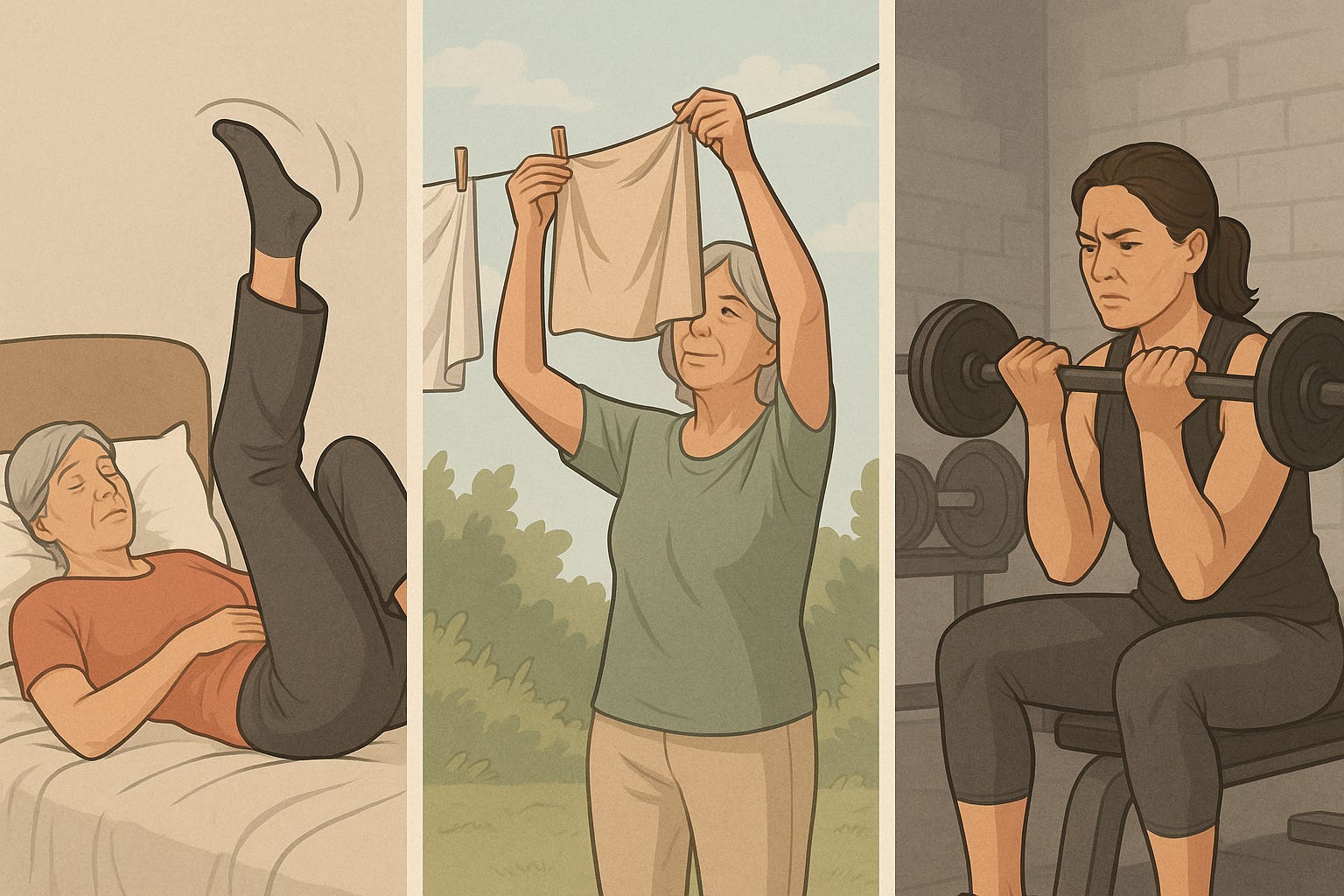
Movement, Mobility, and Exercise: Three Different Medicines
Most people use the word exercise to mean anything that involves moving the body — but the body doesn’t see it that way. It recognises three very different categories:
Movement → Mobility → Exercise
and they only become possible in that order.
Understanding this sequence is critical for anyone living with chronic fatigue, post-viral syndromes, fibromyalgia, long COVID, or any “system collapse” condition.
The wrong type of movement at the wrong time makes people worse — and the right type can gently restart the entire healing loop.
If you’ve ever been told by a doctor to exercise more and get counseling, and fumed all your way home, this is how you do it - the right way.
We will make the distinctions between movement and exercise - which you know you can’t do without crashing - crystal clear.
1. Movement (the foundation level)
Movement is microscopic, gentle, low-ATP, and safe even in a severely depleted body.
It includes things like:
toe wiggling
drawing the alphabet with your feet
hand mudras
tiny arm circles
gentle rocking
swaying while standing
humming (yes, this counts — it moves the diaphragm and fascia rhythmically)
Why it matters
Movement is the only form of physical activity that remains safe when the Five Foundations are underperforming:
ATP is low
Nitric oxide is low
Autonomic nervous system is unstable
Nourishment is insufficient
Movement itself has collapsed
Only micro-movement stays inside the ATP budget.
Movement:
keeps fascia sliding
prevents stagnation
maintains basic circulation
supports nitric oxide production
gently coaxes the autonomic nervous system toward safety
tells the body it is still alive and connected
Movement does not require repair, which is why fragile bodies tolerate it.
2. Mobility (the recovery stage)
Mobility is functional movement — still gentle, but involving coordination, balance, and body-to-brain signalling.
Examples:
standing long enough to make a cup of tea
walking to the letterbox
bending to pick up something
getting dressed
slow, short indoor walks
tai chi / qi gong micro-sequences
wobble board use
gentle swaying that engages the whole body
Why it matters
Mobility begins only when ATP stabilises enough that the body can handle more complex coordination.
Mobility serves a different role:
improves proprioception (your body’s innate sense of its own position, movement, and force in space)
reopens the “whole-body map” in the brain
strengthens connective tissue without strain
gives the mitochondria the signal to build more mitochondria (biogenesis)
re-establishes confidence in upright movement
supports nitric oxide through rhythmic whole-body motion
Mobility is the bridge between survival and recovery.
It is not exercise.
It is controlled, functional movement that rebuilds patterns the body had to abandon during collapse.
3. Exercise (the strengthening stage)
Exercise is deliberate stress placed on the body:
cardiovascular training
resistance work
power or endurance training
long walks or hills
yoga sequences that raise heart rate
anything requiring repair afterward
Why exercise comes last
Exercise only becomes beneficial when:
ATP production is stable enough to support healing
mitochondria are repaired and multiplying
autonomic nervous system stays in parasympathetic calm easily
nourishment is sufficient
mobility has returned without post-exertional crashes
If any of the Five Foundations of healing are still running below threshold, exercise behaves like a system overload:
it drains ATP
triggers sympathetic dominance
creates repair demands the body cannot meet
collapses nitric oxide
leads to PEM or worsening weakness
So exercise is not the cure for collapse. It is the reward once the foundations are rebuilt.
How Movement Feeds the Five Foundations
Movement and mobility don’t sit outside the healing foundations — they plug directly back into them. Once the body begins producing a little more ATP, movement becomes possible again, and that small movement lifts everything else:
it helps digestion and absorption of the nutrients you are consuming
it reassures the autonomic nervous system that it is safe to heal
it opens the nitric oxide pathways, warms the body and improves circulation
it signals the mitochondria to produce more energy — if they can
Movement is the reminder that the whole system is still connected.
At first it simply prevents the terrain from shutting down. Then it triggers a natural feedback loop: each micro-movement makes the next one slightly easier and slightly more appealing.
Mobility is the signal that the system is waking back up.
When movement returns, the other foundations rise with it
Putting It All Together
Healing is not about pushing harder.
It’s about using the right kind of movement at the right stage:
1. Movement — when the foundations are weak
Stay alive. Stay connected. Stay safe.
2. Mobility — when the foundations are rebuilding
Reclaim coordination, balance, and mitochondrial signalling.
3. Exercise — when the foundations are strong
Build strength, endurance, and resilience.
This sequence honours biology, not willpower.
If you think others may benefit from my articles and insights
please spread the message by sharing, re-stacking and subscribing.
If you would like to help me keep going despite my battle with serious ill health…
…a PayPal donation will be gratefully received. AI is putting me on a healing path that might even work - each day I get more optimistic that old systems that had shut down are booting back up again, but it does not come cheaply.
Brilliant reframing of what "exercise" actually means when the body's foundations are compromised! The progressive ladder from movement to mobility to exercise makes so much sense biologically. Most rehab programs skip straight to mobility without honouring that initial micro-movement phase, and thats exacty why people crash. Recognizing that tiny movements like toe wiggling actually serve a real purpose in maintaining fascia health really validates what bodies instinctively do when they're in deep recovery mode.